










The best Plausible alternatives & competitors, compared

Contents
Plausible does simple, privacy-friendly website analytics really well. No cookies, no complex setup, no overwhelming dashboards.
But simplicity has trade-offs. Plausible doesn't offer session replay, A/B testing, or feature flags. Key features like funnels and ecommerce tracking are locked behind its Business plan. And there's no free tier – just a 30-day trial.
If you've outgrown Plausible or need more from your analytics stack, this guide compares the best alternatives – whether you want a similarly lightweight tool or a full platform for building better products.
1. PostHog
- Founded: 2020
- Similar to: Heap, Matomo
- Typical users: Engineers and product teams
- Typical customers: Mid-size B2Bs and startups
What is PostHog?
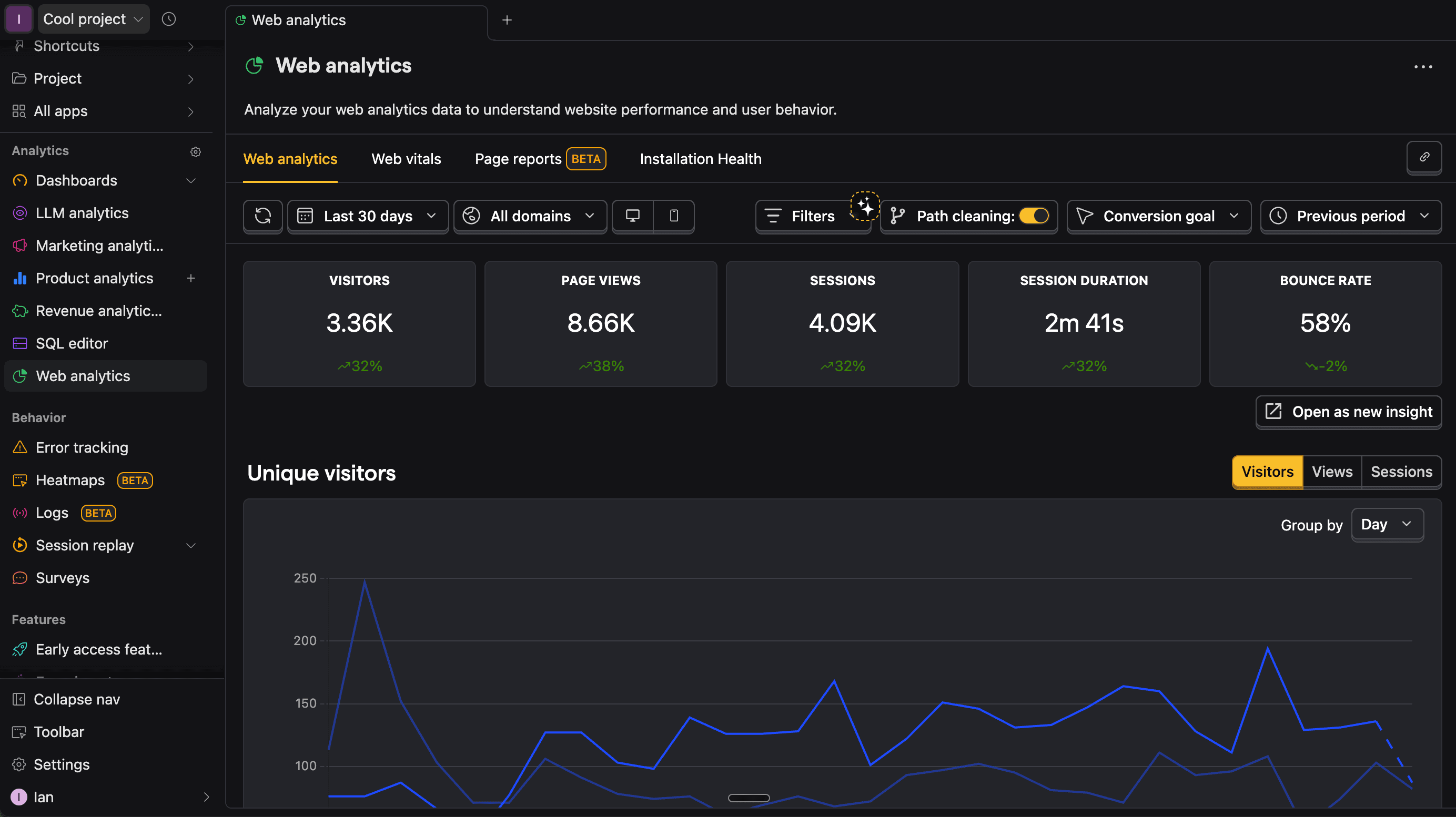
PostHog (that's us 👋) is an all-in-one platform combining web analytics, product analytics, session replay, A/B testing, feature flags, user surveys, and more into one product. This means it's not only an alternative to Plausible but also tools like Mixpanel, Hotjar, and LaunchDarkly.
Key features
Web analytics: Monitor your web traffic by automatically capturing and calculating metrics like visitors, pageviews, session duration, and bounce rate. See the sources, entry and exit paths, channels, and more.
Product analytics: Custom trends, funnels, user paths, retention analysis, and segment user cohorts. Also, direct SQL querying for power users.
Session replays: View exactly how users are using your site. Includes event timelines, console logs, network activity, and 90-day data retention.
Surveys: Target surveys by event or user properties. Templates for net promoter score (NPS), product-market fit (PMF) surveys, and more.
A/B tests: Optimize your app and website with up to nine test variations and track impact on primary and secondary metrics. Automatically calculate test duration, sample size, and statistical significance.
How does PostHog compare to Plausible?
Plausible focuses on web analytics. PostHog includes web analytics but also offers a full suite of tools to help you build a better site and product. On top of this, you can use all of the features of PostHog for free forever. Plausible costs a minimum of $9/month.
Main differences between PostHog and Plausible
- PostHog's free tier includes 1 million events/month; Plausible has a limited 30-day free trial – after that, plans start at $9/month for 10k pageviews.
- PostHog includes session replay, A/B testing, feature flags, surveys, error tracking, LLM analytics, and more; Plausible focuses exclusively on web analytics.
- PostHog offers SQL access for custom queries and a built-in data warehouse for importing external data; Plausible offers CSV exports and a Stats API.
- PostHog supports web, mobile, and backend tracking with SDKs for every major platform; Plausible is web-only with a single JavaScript snippet.
Main similarities between PostHog and Plausible
- Both are open source with publicly available codebases on GitHub.
- Both support cookieless tracking and can be used without cookie consent banners.
- Both are GDPR-ready with EU data hosting options.
- Both offer clean, simple web analytics dashboards with pageviews, visitors, bounce rate, and referrers.
- Both support custom events, UTM tracking, and conversion goals.
- Both support reverse proxying to avoid ad blockers.
Why do companies use PostHog?
According to reviews on G2, companies use PostHog because:
It replaces multiple tools: PostHog can replace Plausible (web analytics), Amplitude (product analytics), and Fullstory (session replay). This simplifies workflows and ensures product data is all in one place.
Pricing is transparent and scalable: Reviewers appreciate how PostHog's pricing scales as they grow. There's a generous free tier they can use forever. Companies eligible for PostHog for Startups also get $50k in additional free credits.
They need a complete picture of users: PostHog includes every tool necessary to understand users and improve products. This means creating funnels to track conversion, watching replays to see where users get stuck, testing solutions with A/B tests, and gathering feedback with user surveys.
Bottom line
Because PostHog is free, has web analytics and more, and still has the privacy and compliance features Plausible offers, it makes for a great alternative, especially for developers and startups.
2. Fathom
- Founded: 2018
- Similar to: Plausible, Google Analytics
- Typical users: Founders and content teams
- Typical customers: Privacy-conscious, content-focused websites
What is Fathom?
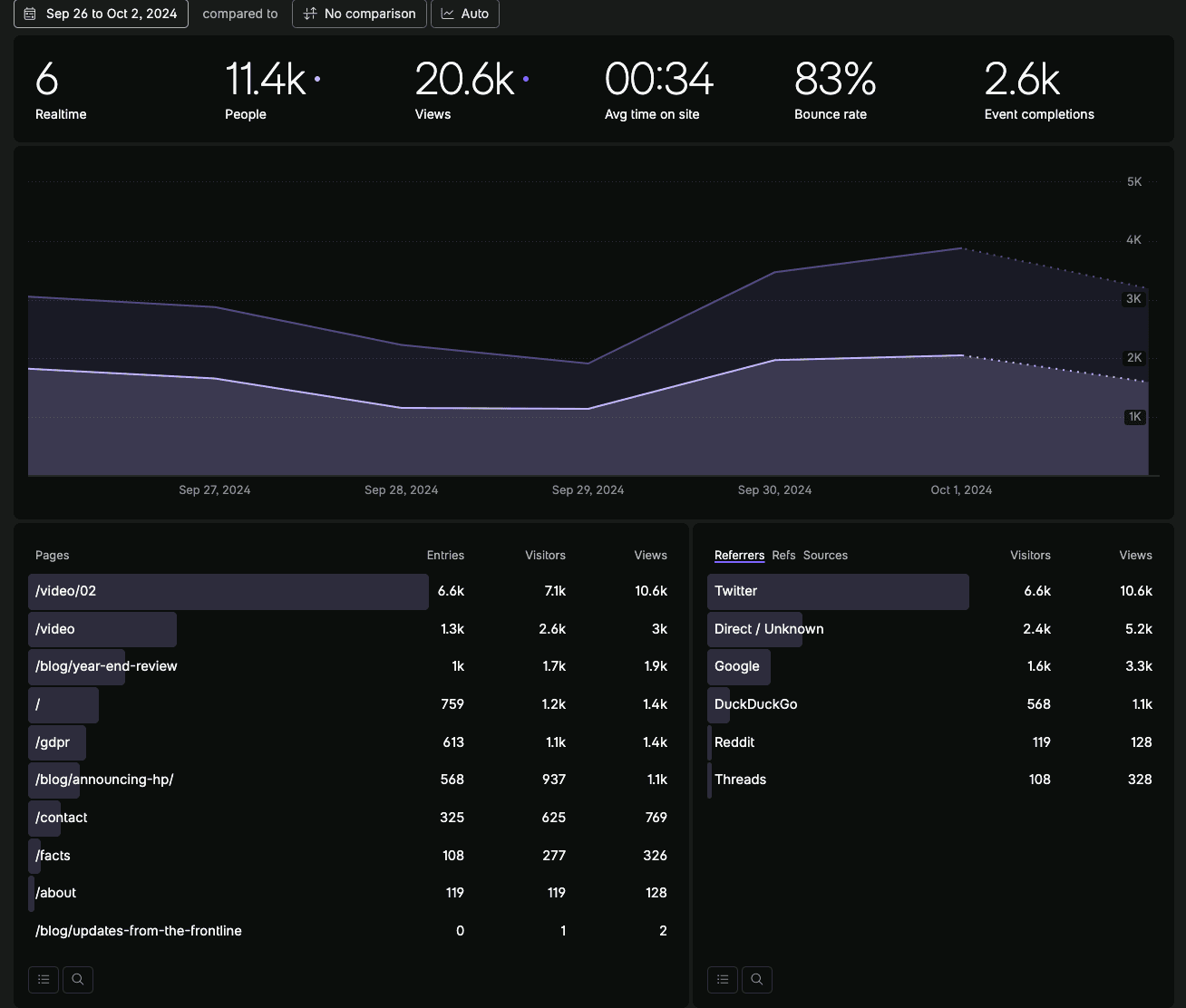
Fathom is a privacy-focused Google Analytics alternative. It is a simple web analytics tool that captures details on traffic, sessions, referrers, sources, and campaigns. It does this while helping users stay compliant and avoid cookies.
Key features
Simple web analytics: Fathom provides a simple, GA-like experience to monitor your website and get an overview of your traffic.
Cookieless: Avoid cookie banners and track your site without using cookies.
Marketing metrics: Track the sources, devices, browsers, locations, UTMs, and more for your traffic.
Conversions: Track custom events and analyze them as conversions towards a goal.
How does Fathom compare to Plausible?
Feature-wise, Plausible and Fathom are nearly identical. Looking closer, however, Fathom is missing some of the compliance features Plausible offers, like open source code.
Main differences between Fathom and Plausible
- Plausible is open source (AGPL license) with a self-hostable Community Edition; Fathom is closed-source and cloud-only.
- Plausible is fully EU-hosted on European-owned infrastructure; Fathom is Canadian-based with EU isolation for visitor data routing.
- Plausible offers conversion funnels on its Business plan; Fathom doesn't have native funnel analysis.
- Plausible integrates with Google Search Console for SEO data in-dashboard; Fathom doesn't offer this integration.
- Fathom starts at $15/month for 100k pageviews; Plausible starts at $9/month for 10k pageviews, making it cheaper at low volumes but more expensive as traffic grows beyond 2M pageviews.
Main similarities between Fathom and Plausible
- Both are privacy-first analytics tools designed as Google Analytics alternatives.
- Both use cookieless tracking and don't require cookie consent banners.
- Both offer simple, single-page dashboards with pageviews, visitors, referrers, and sources.
- Both support custom events, UTM campaign tracking, and conversion goals.
- Both offer email reports and uptime monitoring.
- Both support Google Analytics data import for easy migration.
- Neither offer session replay, A/B testing, feature flags, or product analytics.
💡 Good to know: Fathom isn't entirely EU hosted, but instead attempts to stay compliant with European regulation by:
- Being a Canadian company. The European Commission determined that Canada has an adequate level of data protection.
- Having EU isolation so visitor data is routed and stored on EU servers.
- Having a data processing agreement (DPA) available.
Why do companies use Fathom?
Fathom has limited reviews on G2, but much more praise on social. Judging from social posts, the main reasons people choose Fathom are:
Privacy-focus: Fathom reviewers almost always praise its focus on privacy. This allows users to stay compliant with regulations like GDPR, CCPA, and more.
Ease of use: Reviewers find Fathom is simple to set up and simple to understand. Less technical users find this especially helpful.
Migration from GA: Thanks to both its Google Analytics importer and its relatively similar interface, reviewers find the migration from GA to Fathom relatively easy.
Bottom line
Fathom and Plausible both provide a simple web analytics experience. Depending on your regulatory needs, it is one to consider, but it is missing some of the features users choose Plausible for.
3. Matomo
- Founded: 2007
- Similar to: Piwik Pro, Google Analytics
- Typical users: Marketing and ecommerce teams
- Typical customers: Privacy-focused former GA users
What is Matomo?
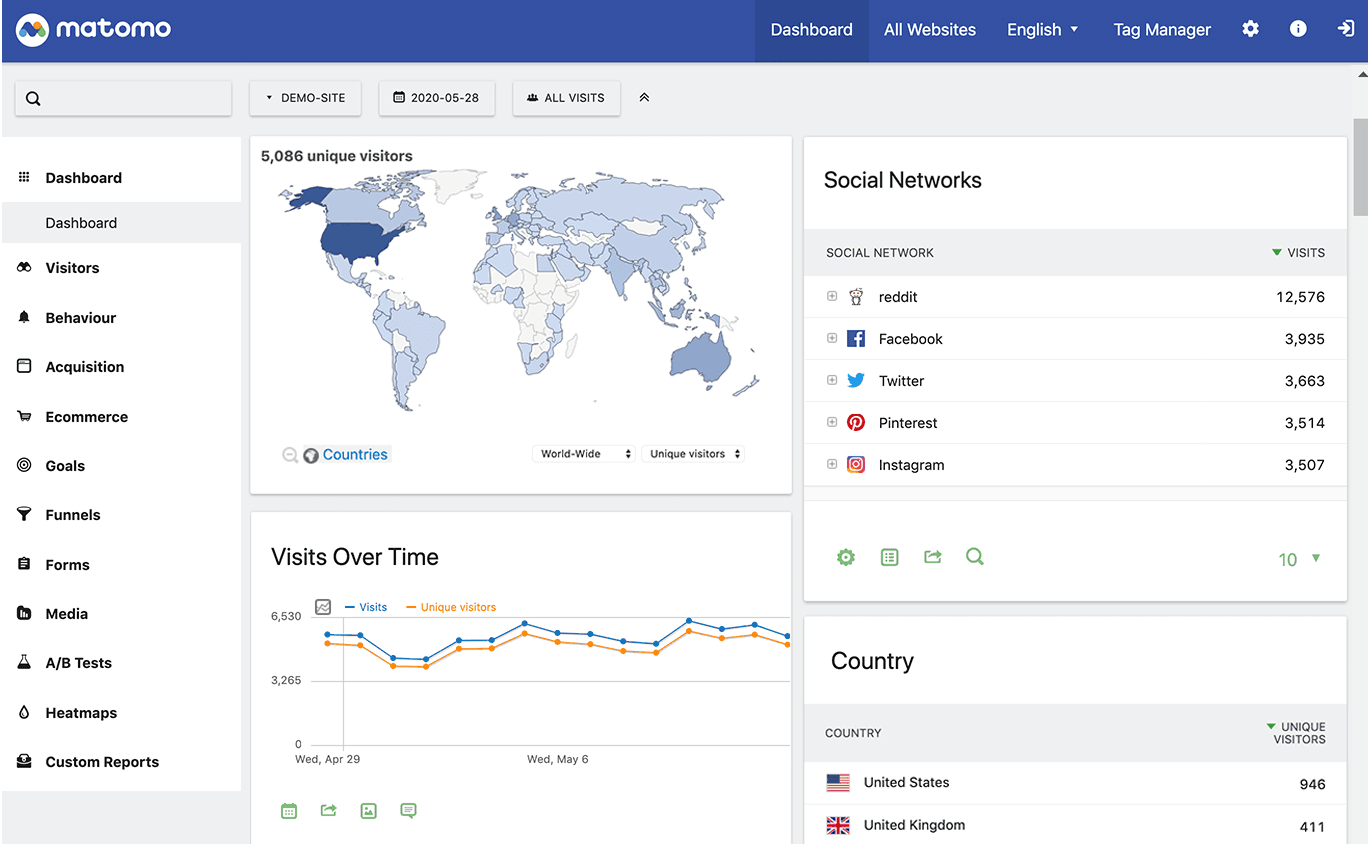
Matomo is a fully-featured, privacy-focused Google Analytics alternative. It contains basic web analytics along with more advanced product and behavioral analytics features. This includes features like funnels, cohorts, session recordings, and heatmaps.
Key features
Web analytics: Get an overview of your traffic, popular pages, sources, referrers, and more.
Custom reports: Get detailed reports on product usage, cohorts, funnels, and conversion goals.
Marketing analysis: Combine traffic insights with channel attribution, keyword data, ad performance, and more.
Ecommerce: Integrate with popular ecommerce platforms and track sales, products, and conversions.
How does Matomo compare to Plausible?
Matomo is more of a like-for-like alternative to Google Analytics, meaning it has many more features than Plausible. Both are also privacy-focused, open source, and only have trials, not free tiers.
Main differences between Matomo and Plausible
- Matomo includes paid plugins for session recordings, heatmaps, and A/B testing; Plausible focuses exclusively on web analytics.
- Matomo offers a fully self-hostable version for free with no event limits; Plausible's self-hosted Community Edition excludes premium features like funnels and ecommerce tracking.
- Matomo has a GA-like interface with multi-page reports, custom dashboards, and segmentation; Plausible keeps everything on a single-page dashboard.
- Matomo offers ecommerce integrations with WooCommerce, Shopify, and Magento out of the box; Plausible's ecommerce revenue tracking is limited to its Business plan.
- Matomo uses cookies by default (with a cookieless option); Plausible is cookieless by design and never uses cookies.
- Matomo's cloud pricing starts higher and scales based on traffic; Plausible's subscription tiers are simpler and cheaper at lower volumes.
Main similarities between Matomo and Plausible
- Both are open source and privacy-focused Google Analytics alternatives.
- Both offer EU hosting and GDPR compliance.
- Both support self-hosting for full data ownership.
- Both track pageviews, visitors, referrers, sources, UTM campaigns, and conversion goals.
- Both integrate with Google Search Console for SEO data.
- Both support custom events for tracking actions beyond pageviews.
- Both have active communities and long track records in the privacy analytics space.
Why do companies use Matomo?
According to reviews on G2, people choose Matomo because:
On-premise: Reviews appreciate that Matomo can be hosted and run from your own servers, keeping them in full control of their data.
Privacy: Matomo is open-source, self-hostable, and community-focused. The combination of these creates a privacy-focused platform reviewers appreciate.
GA-like: Matomo's feature set is very similar to Google Analytics. This means users can do the analysis they are familiar with on a more privacy-friendly platform.
Bottom line
Matomo is a solid alternative to Plausible thanks to its similar, but expanded feature set and focus on privacy. For advanced Google Analytics users, it's an especially good choice.
4. Heap
- Founded: 2013
- Similar to: PostHog, LogRocket
- Typical users: Product and marketing teams
- Typical customers: B2C SaaS and ecommerce companies with a user experience focus.
What is Heap?
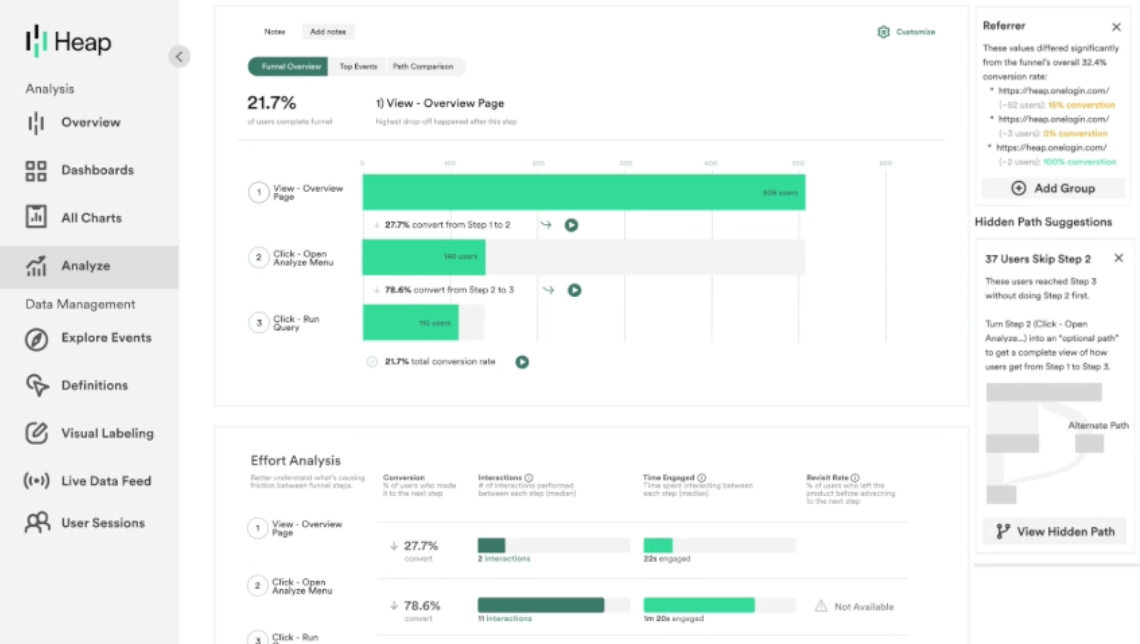
Heap describes itself as a digital insights platform. This means it offers both product analytics and session replay and supports marketing use cases with multi-touch attribution. Contentsquare, a marketing and ecommerce analytics firm, acquired Heap in September 2023 and announced plans to integrate the two products.
Key features
Event autocapture: Product teams don't need to rely on engineers to instrument all events. Heap has a visual editor for teams to tag events directly on-page for analysis.
Session replay: Get qualitative insights about user behavior by replaying their session - although this lacks the debugging tools typical of most replay tools.
Heatmaps: See where people click, what point they scroll to, and the areas that get the most attention.
Analysis suggestions: Advanced data science capabilities discover hidden interactions, friction points, and knowledge about key paths.
Managed ETL: Connect to data warehouses, so you can combine your analytics with other sources and get a fuller picture of the entire user journey.
How does Heap compare to Plausible?
Heap has much more of a product focus than Plausible. This means it lacks the easy-to-use web analytics features, but makes up for it with product analytics, session replay, and more. It also isn't open source or hostable in the EU.
Main differences between Heap and Plausible
- Heap is a product analytics platform with funnels, retention, cohorts, and user paths; Plausible focuses on simple website traffic metrics.
- Heap includes session replay and heatmaps as paid add-ons; Plausible doesn't offer either.
- Heap's autocapture automatically records clicks, form submissions, and pageviews without manual instrumentation; Plausible requires you to define custom events manually.
- Plausible is open source, cookieless, and EU-hosted; Heap is closed-source, uses cookies, and doesn't offer EU data residency.
- Plausible starts at $9/month with transparent pricing; Heap's pricing is sales-driven and opaque beyond its limited free tier (10k sessions/month).
Main similarities between Heap and Plausible
- Both are self-serve with free or trial options to get started (Heap has a 14-day free trial while Plausible has a 30-day free trial).
- Both track pageviews, custom events, and user interactions.
- Both support integrations with data warehouses like Snowflake and BigQuery.
- Both offer simple setup with a single script snippet.
- Both are positioned as alternatives to Google Analytics, though for different use cases.
Why do companies use Heap?
According to G2 reviews, companies enjoy these three areas of Heap:
Autocapture: Non-technical users love how easy autocapture makes tracking on their site. Along with the element data included, this provides a huge amount of useful analytics data with little setup.
Simple setup: It does not take a big technical effort to set Heap up. Users can add a single script and begin collecting data. They then make it easy to visualize that data through user paths, funnels, and session replays.
Streamlining analysis: By having analytics and session replay data in one place, Heap makes it easy to understand the usage of their app or site. This replaces interviews or user testing and makes the development cycle faster.
Bottom line
Heap is a good alternative for teams focused on improving their product. For web or privacy-focused teams, there are likely better options.
5. Piwik Pro
- Founded: 2013
- Similar to: Matomo, Google Analytics
- Typical users: Marketing and analysis teams
- Typical customers: European enterprises in strict regulatory situations
What is Piwik Pro?
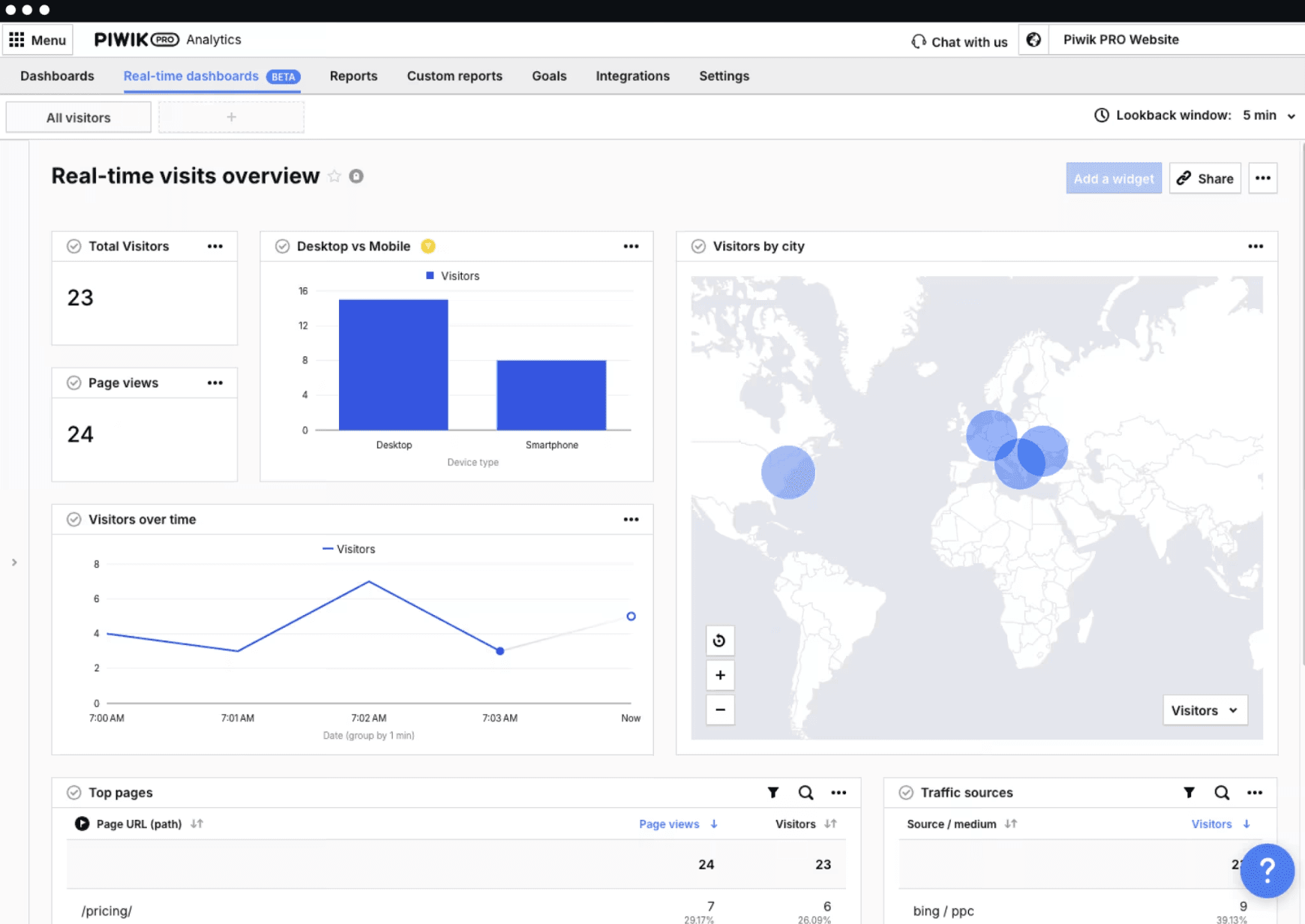
Piwik Pro is a suite of privacy respecting analytics tools. These include web, mobile, and product analytics as well as tag and consent management. It is targeted at users in a strict regulatory environment.
Piwik Pro spun out as a paid fork of Matomo in 2013. Since then, it has added compliance-focused features as well as a range of integrations with tools like Looker, Google Search Console, and Google Ads.
Key features
Analytics: Create custom dashboards with trends, charts, flows, funnels, and more to analyze your analytics.
Tag manager: Manage tags, pixels, and JavaScript snippets from a range of platforms.
Consent manager: Collect and manage consent to track and use personal information. Customize and tailor banners for different situations.
Customer data platform: Integrate with other tools and capture data to have it all in one place. Send data from Piwik Pro to other tools.
How does Piwik Pro compare to Plausible?
Piwik Pro takes a more heavyweight approach to compliance with its consent and tag management features.
Main differences between Piwik Pro and Plausible
- Piwik Pro includes built-in tag management and consent management for handling cookies and tracking scripts; Plausible is cookieless by design and doesn't need either.
- Piwik Pro offers a customer data platform for integrating with third-party tools and syncing audiences; Plausible has limited integrations beyond basic webhooks and CSV exports.
- Piwik Pro has a GA-like interface with multi-page reports, custom dashboards, and advanced segmentation; Plausible keeps everything on a single-page dashboard.
- Plausible is open source with a self-hostable Community Edition; Piwik Pro is closed-source and cloud or private cloud only.
- Plausible's script is lightweight (~1KB) and cookieless by default; Piwik Pro's tracking is heavier and typically uses cookies alongside its consent manager.
Main similarities between Piwik Pro and Plausible
- Both are privacy-focused analytics tools positioned as Google Analytics alternatives.
- Both offer EU hosting and GDPR compliance.
- Both support custom events, conversion goals, and funnel analysis.
- Both integrate with Google Search Console for SEO data.
- Both are popular with European companies in regulated industries.
- Both support cookieless tracking modes for privacy-first setups.
Why do companies use Piwik Pro?
Based on reviews from G2, the following summarizes of reasons why users choose Piwik Pro:
GA-like: Google Analytics users find that the transition to Piwik Pro is an easy one thanks to their similar dashboards and data models.
Compliance: Those in strict regulatory environments appreciate how Piwik Pro provides many of the tools they need to stay compliant like tag and consent management.
Control: Reviewers like that they are in control of their data, tune it to their needs, and host it outside the US.
Bottom line
For users looking for the compliance features Piwik Pro offers, it's a good alternative to Plausible, especially because of Piwik Pro's strong privacy focus.
6. Umami
- Founded: 2022
- Similar to: Fathom, Plausible
- Typical users: Developers and content-focused teams
- Typical customers: Small devs and large content-focused enterprises
What is Umami?
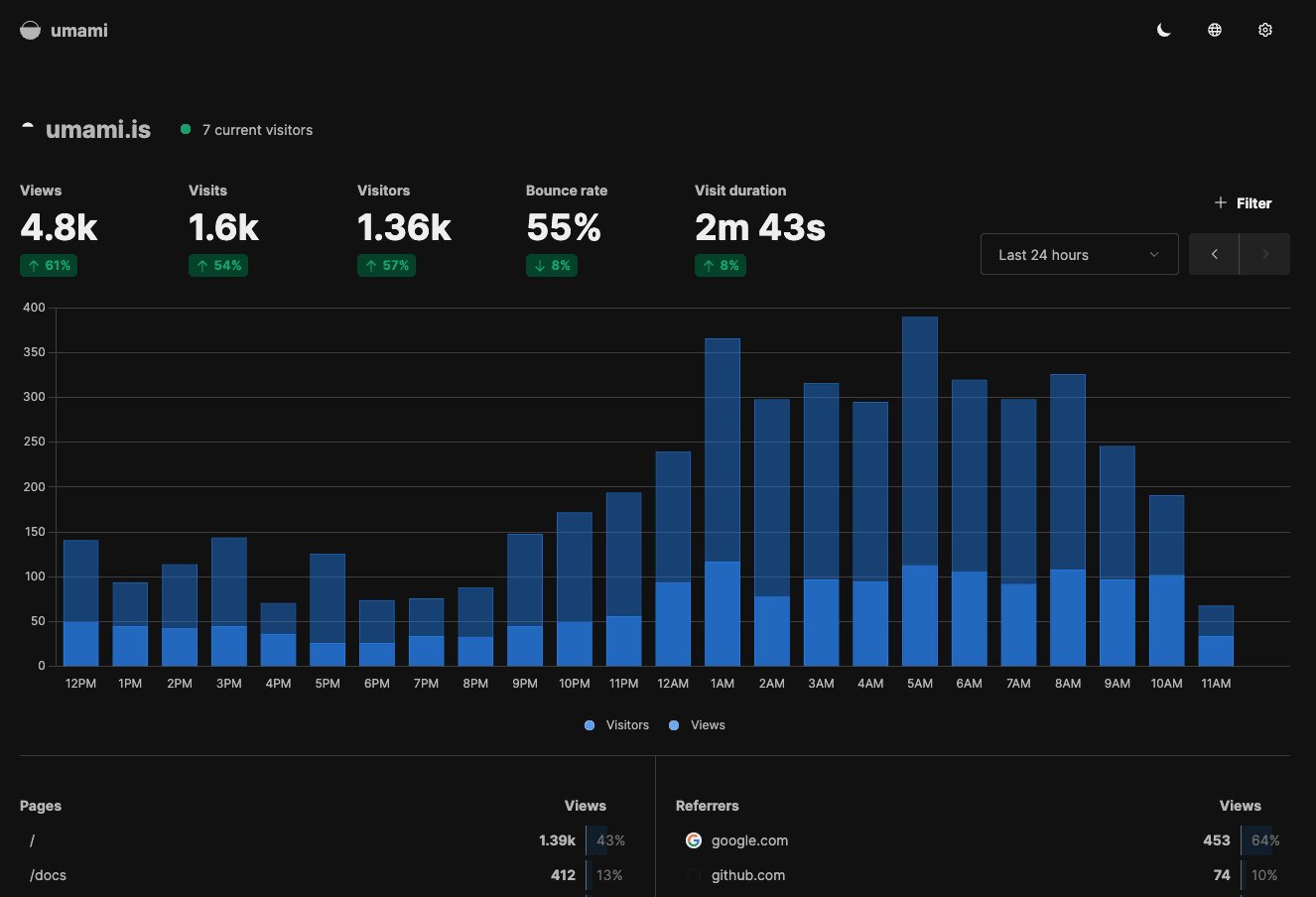
Umami is an open source, easy-to-use Google Analytics alternative. Like other similar tools, it is privacy friendly, meaning data is anonymized, no personal data is saved, you don't need a cookie banner, and it complies with GDPR.
Key features
Visitor insights: Breakdown the sources of your traffic. See the browsers, locations, devices, and OS they use.
Custom events: Track more than pageviews. Capture custom events wherever they happen on your site.
Open source: See all of the code, run and host it yourself, modify it for your needs, and contribute to it.
Realtime: Get a view into the live stats for your site. See how many current visitors you have.
How does Umami compare to Plausible?
Umami is one of the most similar tools to Plausible on this list. It is open source, privacy focused, and even has a similar metrics dashboard. While it does lack some of the features of Plausible, Umami does have a free cloud hosted option.
Main differences between Umami and Plausible
- Umami has a free cloud tier (3 sites, 100k events/month); Plausible has no free tier – plans start at $9/month.
- Plausible offers conversion funnels and ecommerce revenue tracking on its Business plan; Umami doesn't have native funnel analysis.
- Plausible supports custom event properties for richer event data; Umami tracks custom events but with limited property support.
- Umami's open-source edition is more permissive and full-featured; Plausible's Community Edition excludes premium features like funnels and ecommerce.
- Plausible has a larger user base and more mature ecosystem with email reports, Slack integration, and a Looker Studio connector; Umami's integration options are more limited.
Main similarities between Umami and Plausible
- Both are open source, privacy-first web analytics tools positioned as Google Analytics alternatives.
- Both use cookieless tracking and don't require consent banners.
- Both offer clean, single-page dashboards with pageviews, visitors, referrers, and sources.
- Both support custom events, UTM campaign tracking, and real-time visitor data.
- Both can be self-hosted for full data ownership.
- Both are GDPR-compliant and don't collect personal data.
- Both are lightweight with minimal impact on page load speed.
Why do companies use Umami?
According to its few G2 reviews and mentions on social, users choose Umami because of:
Simple setup: Reviewers find that Umami is easy to setup, self-host, and add to their site.
Free plan: Users appreciate they can use Umami for 3 sites and 100k events for free.
Minimal design: Umami's clean and simple UI is a selling point for some reviewers.
Bottom line
Umami is a like-for-like alternative to Plausible. For users looking for a privacy-focused, open source, and simple web analytics tool, it's a good choice.
7. Google Analytics
- Founded: 2005
- Similar to: Matomo, Piwik Pro
- Typical users: Marketing and business teams reliant on Google's ecosystem
- Typical customers: Small businesses and massive enterprises
What is Google Analytics?
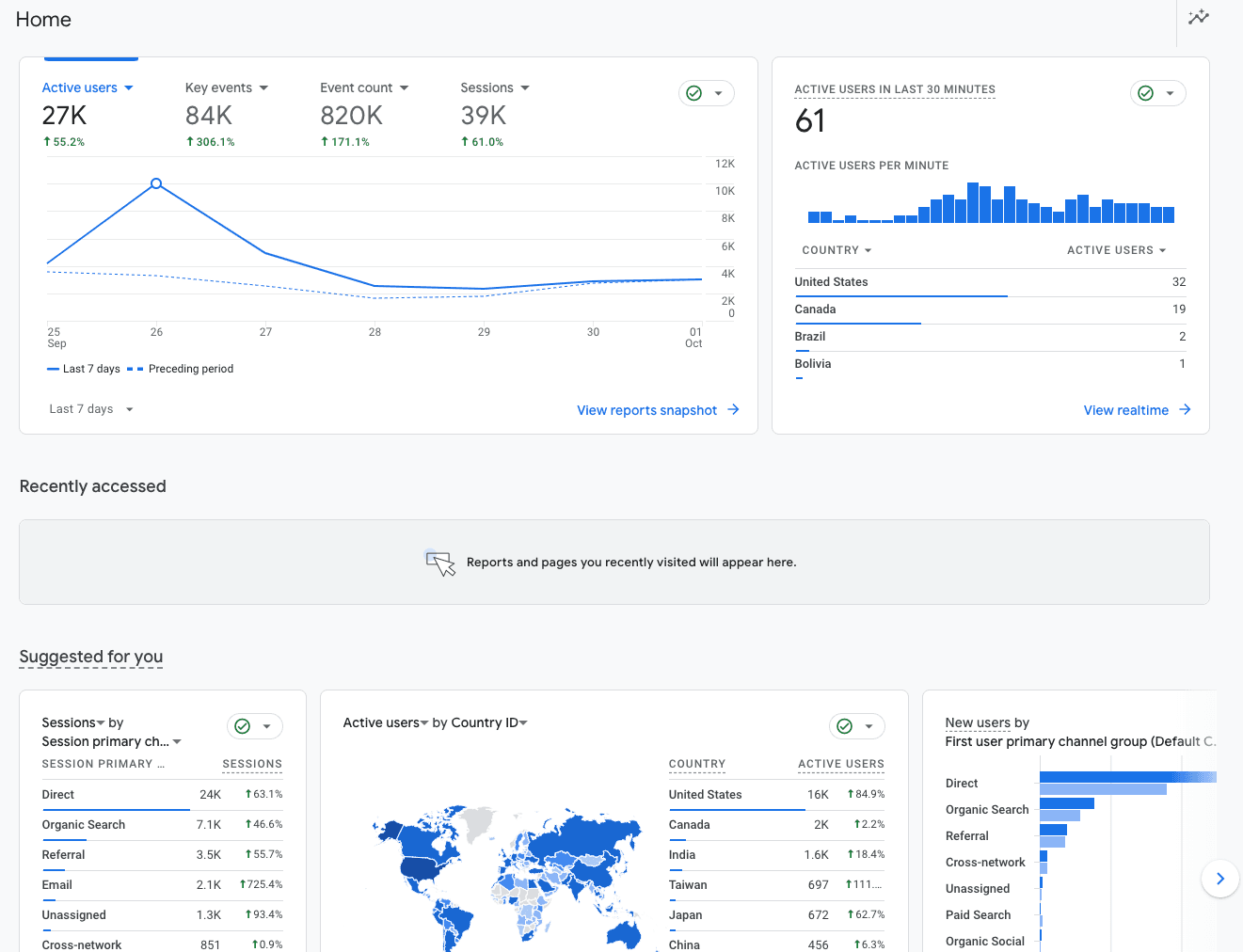
Google Analytics has long been the go-to choice for website and app analytics thanks to Google's huge market share, a large amount of informational content, and its connection with the rest of the Google suite.
Google Analytics recently switched fully over from session-based Universal Analytics (GA3) to event-based GA4. This also introduced conversion funnels and retention tables that product teams are fans of.
According to BuiltWith, as of October 2024, a whopping 489,524 of the top 1 million websites deploy Google Analytics. Massively more than the 3,500 using Plausible.
Key features
Flexible reporting: GA has pre-built insights as well as fully customizable ones to fit your reporting requirements.
Predictive insights: Alert you to trends you're not aware of, like an increase in traffic to a specific landing page, or an anomalous decline in conversion from one period to another.
Integration with Google tools: It's easy to combine and analyze your GA4 data with tools like Looker Studio, Google Ads, BigQuery, and Firebase.
Natural language search: Ask specific questions, like "MoM growth in users on iOS", rather than searching existing reports.
Revenue metrics: Connect metrics to marketing spend and revenue conversion to get a full picture of ROI.
How does Google Analytics compare to Plausible?
Plausible positions itself as a privacy-focused alternative to Google Analytics. It doesn't have as many features, but for many users, the privacy trade-off is worth it.
Main differences between Google Analytics and Plausible
- GA4 uses cookies and collects personal data by default, requiring consent banners in the EU; Plausible is cookieless and doesn't collect personal data.
- GA4 is free for up to 10M events/month but data is processed on Google's US servers; Plausible is paid but all data stays on EU-owned infrastructure.
- GA4 offers advanced features like predictive insights, audience building, and advertising attribution; Plausible focuses on essential web metrics only.
- GA4 integrates deeply with Google Ads, BigQuery, Looker Studio, and Firebase; Plausible has limited integrations beyond Google Search Console and Looker Studio.
- GA4 has a steep learning curve with multi-layered reports and a complex interface; Plausible puts everything on a single, simple dashboard.
- GA4 is closed-source and owned by Google; Plausible is open source and independently owned.
Main similarities between Google Analytics and Plausible
- Both track pageviews, visitors, referrers, traffic sources, and user geography.
- Both support custom events and conversion goal tracking.
- Both integrate with Google Search Console for organic search data.
- Both offer UTM campaign tracking for marketing attribution.
- Both support real-time visitor monitoring.
- Both are used by a wide range of businesses from small sites to large enterprises.
Why do companies use Google Analytics?
According to G2, users choose Google Analytics for:
Website traffic: The main use case reviewers praise GA for simply understanding their website's traffic, where it comes from, and what they do on the site.
Connection to marketing: Marketers like that it connects to marketing tools like Ads and Search Console. This helps them analyze the overall effectiveness of marketing efforts.
AI insights: Reviewers appreciate the fact that GA surfaces insights automatically and makes predictions. This helps them find new ways of improving their site.
Bottom line
Google Analytics is the default web analytics tool for many teams. Its integrations with other Google tools make it hard to beat for users reliant on that ecosystem. For privacy-focused teams, or ones looking for an easy-to-use tool, there are better options.
Which Plausible alternative should you choose?
- Need more than web analytics – like session replay, A/B testing, feature flags, and error tracking? PostHog goes far beyond pageviews and won't cost you a thing to start.
- Want a near-identical experience to Plausible with a free cloud tier? Umami is the closest match.
- Privacy-focused but need a GA-like feature set with funnels, heatmaps, and ecommerce? Matomo bridges the gap.
- Looking for the simplest possible dashboard with strong privacy credentials? Fathom keeps it minimal.
- Enterprise team needing consent management, tag management, and strict compliance? Piwik Pro is built for regulated environments.
- Heavily invested in Google Ads, BigQuery, and the Google ecosystem? Google Analytics is hard to beat for marketing attribution.
Is PostHog right for you?
Here's the (short) sales pitch.
We're biased, obviously, but we think PostHog is the perfect Plausible replacement if:
- You want all the tools to help you build a better product (like product analytics and session replays).
- You want to try before you buy. We're self-serve with a generous free tier.
- You value transparency. We're open source and open core.
Check out our product pages and read our docs to learn more.
Frequently asked questions
What is Plausible used for?
Plausible is a lightweight, privacy-first web analytics tool used to track website traffic – pageviews, visitors, referrers, top pages, UTM campaigns, and conversion goals. It's designed as a simpler, cookieless alternative to Google Analytics that doesn't require consent banners.
Why look for Plausible alternatives?
Common reasons include: needing product analytics with funnels, retention, and cohorts beyond basic web metrics; wanting session replay or A/B testing alongside analytics; needing a free tier (and not just a limited free trial); wanting features like funnels and ecommerce tracking that Plausible locks behind its Business plan; or needing mobile and backend tracking that Plausible doesn't support.
What's the best Plausible alternative overall?
For most teams, PostHog is the best alternative. It includes web analytics with a similarly simple dashboard, plus product analytics, session replay, A/B testing, feature flags, surveys, and error tracking – all with a free tier that covers 1 million events/month.
Which Plausible alternatives are open source?
PostHog, Matomo, Umami, and Plausible itself are all open source. Plausible's Community Edition excludes premium features like funnels and ecommerce. Matomo's self-hosted version is fully featured. Umami's open-source edition is also full-featured. See our guide to the best open-source analytics tools for more.
Which Plausible alternative has the best free tier?
PostHog offers the most generous free tier: 1 million events, 5,000 session replays, 1 million feature flag requests per month, and more. Umami offers a free cloud tier for 3 sites and 100k events/month. Piwik Pro offers a free tier up to 500k actions/month. Google Analytics is free for up to 10M events/month. Plausible has no free tier – only a 30-day trial.
Which alternative is best if I just want simple web analytics?
Fathom and Umami are the most similar to Plausible in simplicity. Both offer clean single-page dashboards, cookieless tracking, and privacy compliance. Umami has a free tier; Fathom starts at $15/month for 100k pageviews.
Which alternative is best for ecommerce?
Matomo is the strongest choice for ecommerce, with native integrations for WooCommerce, Shopify, and Magento, plus revenue tracking and multi-channel attribution. Google Analytics is also popular for ecommerce teams already using Google Ads. Plausible offers basic ecommerce revenue tracking but only on its Business plan.
Which alternative is best for regulated industries?
Piwik Pro is purpose-built for strict regulatory environments with built-in consent management, tag management, and EU hosting. Matomo also offers strong compliance with self-hosting for full data ownership. PostHog is SOC 2 certified, HIPAA-ready, and offers EU hosting.
Can I use Plausible alternatives without cookies?
Yes. PostHog, Fathom, Umami, and Piwik Pro (in cookieless mode) all support tracking without cookies. Matomo uses cookies by default but offers a cookieless configuration. Google Analytics uses cookies and typically requires consent banners in the EU.
Can I migrate from Plausible to PostHog?
Yes. See the Plausible to PostHog migration guide for step-by-step instructions on importing your historical data.
Can I migrate from Google Analytics to PostHog?
Yes. See the Google Analytics to PostHog migration guide for details on importing your GA data.
What other web analytics tools are available?
Beyond the tools in this guide, there are many more options. See our guides to Google Analytics alternatives, Fathom alternatives, Matomo alternatives, and the best web analytics tools for broader comparisons.
PostHog is an all-in-one developer platform for building successful products. We provide product analytics, web analytics, session replay, error tracking, feature flags, experiments, surveys, LLM analytics, data warehouse, CDP, and an AI product assistant to help debug your code, ship features faster, and keep all your usage and customer data in one stack.